 |
Yellow Ophrys Ophrys lutea
© Teresa Farino
Wildlife of Western Portugal
A superb springtime destination for the all-round naturalist
|
Leader: | Teresa Farino
| |
2008 Dates: | Sun. 9 March - Sun. 16 March
| |
Price: | £750 per person (single-room supplement £100), excluding flights
|
The vast estuary of the mighty Rio Tejo - a veritable maze of saltmarsh, salinas, brackish polders and
intertidal mudflats - is of international significance for its aquatic birds, both wintering and breeding,
despite lying slap-bang on top of Portugal's capital city. To the south lies the equally immense Sado estuary,
home to a resident population
of bottle-nosed dolphins and incorporating the impressive sandspit of Tróia, with its superb dune flora. The
two are separated by the Setúbal peninsula, dominated by the whaleback limestone ridge of the
Serra da Arrábida, clothed in some of the country's
best-preserved Mediterranean habitats, which extends westwards as a high plateau - rich in spring-flowering bulbs --
before terminating in the spectacular cliffs of Cabo Espichel.
Cliffs of Azóia
© Teresa Farino
From a comfortable base on the Altiplano de Azóia, close to Cabo Espichel, we will explore the surrounding
limestone plateau, both the Tejo and Sado estuaries, the luxuriant evergreen scrub of the Serra da Arrábida,
Tróia's pristine sand-dune vegetation and the vast reedbed of the Lagoa de Albufeira. The whole area is a
superb destination for the naturalist, with something of interest around every corner.
Immediately around the hotel, the Altiplano de Azóia is a botanical treasure-trove at
this time of year, hosting palmate anemone, hoop-petticoat daffodils (subspecies obesus), Romulea bulbocodium, Barbary
nut, Scilla monophyllos, wild tulip and many orchids, including naked man, pink butterfly and conical, as well as
bumble-bee, sawfly, yellow and woodcock ophrys. Birdwise, we should look out for crested lark, Dartford and
Small Copper Lycaena phlaeas
© Teresa Farino
Sardinian warblers and southern grey shrike here, with the adjacent sea-cliffs housing a breeding pair of peregrines.
The nearby Serra de Arrábida, rising
to just 501m, is clothed with dense evergreen scrub, among which we should encounter friar's-cowl, two-leaved gennaria
and Spanish bluebell, while to the north, the windmill-topped ridge of the Serra do Louro is also renowned for its
orchids, particularly early spider and mirror ophrys. The sea-cliffs of Arrábida are home to breeding Bonelli's eagle,
peregrine and blue rock thrush, while the forested habitats provide refuge for Egyptian mongoose, common genet, western
polecat, beech marten and wildcat, although sightings of these are understandably rare. Butterflies on the wing in early
spring include Spanish festoon, swallowtail and scarce swallowtail, Cleopatra, green-striped and western dappled whites,
small copper, Spanish brown argus and Lang's short-tailed blue, as well as the South African geranium bronze.
Iberian Azure-winged Magpie Cyanopica cooki
© Teresa Farino
The coastal dune ecosystem of the Tróia peninsula displays
a classic profile, with primary colonising species including the fleshy-leaved Iberian endemic Thymus carnosus, coastal
crucianella and cottonweed. Scrophularia frutescens and Corema album, both of which are found only along the western seaboard
of Iberia and North Africa, are characteristic of the stabilised sands of the interior, growing together with the Portuguese
endemic Santolina impressa. Colour is provided by the fluorescent-pink Silene littorea, the glorious blue Anchusa calcarea,
the golden 'sun-roses' of Halimium calycinum and H. halimifolium, shrubby pimpernel and the snapdragon Antirrhinum majus ssp.
linkianum. Thekla lark and Large Psammodromus are among the vertebrate highlights here.
The pine and cork oak forests to the east of both estuaries are home to white stork, crested tit, short-toed treecreeper,
Iberian azure-winged magpie and cirl bunting, as well as attractive plants such as palmate anemone, three-leaved snowflake and
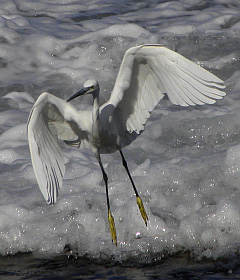
violet limodore. Eye-catching birds such as greater flamingo, little egret, spoonbill and osprey grace the estuarine habitats,
amid a host of more commonplace wintering species such as red-breasted merganser, avocet, godwits and Sandwich tern. A boat-trip
in search of the Sado's bottle-nosed dolphins is one of the highlights of the week.
Romulea bulbocodium
© Teresa Farino
Prices: £750, including half-board, en suite accommodation at the Estalagem dos
Zimbros, picnic lunches, hired minibus transport
throughout, all entry fees and the services of Teresa Farino as leader. A single-room supplement of £100
is applicable.
This is a land-based tour. Flights and travel insurance (obligatory) are the responsibility of the client.
Pick-up details: Having consulted schedules for the cheapest and most convenient flights, Teresa will
be meeting British Airways flight 0502 on 9 March,
which departs London Heathrow at 15.25, arriving in Lisbon at 18.00. For the return trip on 16 March, we will be
travelling to the airport to connect with British Airways
flight 0503, which leaves Lisbon at 18.50, arriving at London Heathrow at 21.35 (all times local).
Alternatively, those travelling to Portugal independently can arrange to meet the group at the hotel on the first evening.
Group size: maximum 8 persons.
Booking information:
please contact Teresa Farino for further details and a booking form, or if you have any queries about this tour.
| E-mail: |
teresa@iberianwildlife.com
|
|
| Office phone: | (+34) 942 735154 |
| Mobile phone: | (+34) 656 337129 |
|
| Address: |
Apartado de Correos 59
39570 Potes
Cantabria
Spain
|
|


