|
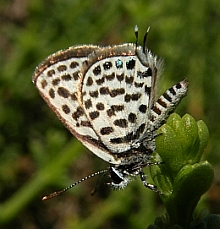 Common Tiger Blue Common Tiger Blue
Tarucus theophrastus© Teresa Farino
Wildlife of Almería
The arid badlands, varied coastal habitats and rugged mountains of the south-eastern corner of Spain are the perfect spring destination for the all-round naturalist, particularly rich in flowers, butterflies, dragonflies and some of Europe's most charismatic and colourful birds.
Almería is perhaps the most arid region of Western Europe, experiencing more than 3,100 hours of sunlight and just 250 mm of precipitation annually. Not surprisingly, the vegetation is very distinctive, harbouring many endemic species; of the thousand-odd taxa of vascular plant known to occur in the Cabo de Gata Natural Park, for example, around 12% are unique to Iberia.
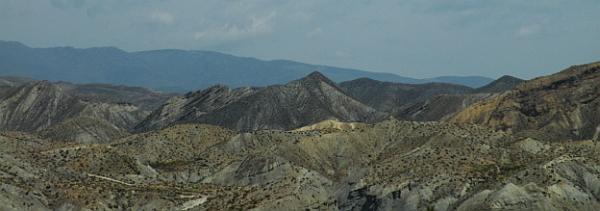 Tabernas, Almería© Teresa Farino Tabernas, Almería© Teresa Farino
From our base in the fishing village of San José, in the western sector of the Cabo de Gata natural park, we are ideally placed to explore all the principal habitats of the region. Coastal sand-dunes harbour spikes of the frankly phallic, parasitic Cynomorium, as well as fluorescent-pink clumps of Silene littorea, Ice-plant, Winged Sea-lavender, Yellow Sea-aster and Cottonweed, while the volcanic hinterland of the park is home to several plants known only from Cabo de Gata - notably the snapdragon Antirrhinum charidemi - as well as Yellow and 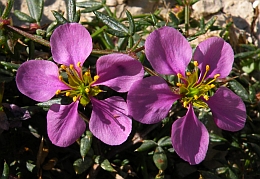 Fagonia Fagonia cretica
© Teresa Farino
Red Horned-poppies, Sea Mallow, the pink-flowered Phlomis purpurea, yellow Phlomis lychnitis and clumps of Dwarf Fan Palm, with one of the botanical gems of the region being the cactus-like Caralluma europaea, a member of the milkweed family (Asclepiadaceae).
Fagonia Fagonia cretica
© Teresa Farino
Red Horned-poppies, Sea Mallow, the pink-flowered Phlomis purpurea, yellow Phlomis lychnitis and clumps of Dwarf Fan Palm, with one of the botanical gems of the region being the cactus-like Caralluma europaea, a member of the milkweed family (Asclepiadaceae).
Excursions further inland will take us into the semi-desert habitats of Tabernas - the backdrop to many a 'Spaghetti Western', where notable plants include the endemic crucifer Euzomodendron bourgaeanum, glorious pink bushes of Limonium insigne and the yellow, broomrape-like Cistanche phelypaea subsp. lutea - as well as the nearby Sierras of Gádor and Los Filabres, where more typically Mediterranean vegetation can be found. Botanical highlights here might
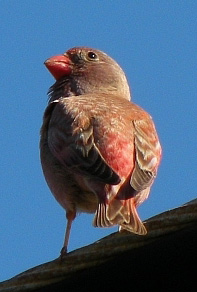 Male Trumpeter Finch
Bucanetes githagineus zedlitzi
© Teresa Farino
include several endemic species of Rock-rose (both white and yellow-flowered), Fagonia, Coris hispanica, the delightful Convolvulus lanuginosus and a number of spring-flowering bulbs, including Field Gladiolus, Barbary Nut, Hollow-leaved Asphodel, Dipcadi, Dense-flowered Orchid and Mirror Ophrys.
Among the more eye-catching birds we can expect to see are Bee-eater, Hoopoe, Black-eared Wheatear, Woodchat and Southern Grey Shrikes and Golden Oriole, while the most emblematic breeding birds of the cliff-lined seasonal watercourses - here known as ramblas - are Eagle Owl, Black-bellied Sandgrouse, Alpine Swift, Rock Dove, Black Wheatear, Rock Sparrow and Trumpeter Finch. Pallid Swifts and Red-rumped Swallows scythe through the air overhead in search of insects, while Sardinian, Dartford and Spectacled Warblers occur in scrubby habitats.
The coastal sand-dunes provide breeding habitat for Kentish Plovers galore, while dry open habitats near the sea are a noted haunt of Stone Curlews and Short-toed, Lesser Short-toed and Thekla Larks. The coastal cliffs of Cabo de Gata are renowned for their breeding Peregrines and Blue Rock Thrushes, with the mountainous hinterland of the park the home
of Red-legged Partridge, Crag Martin and scores of Corn Buntings. 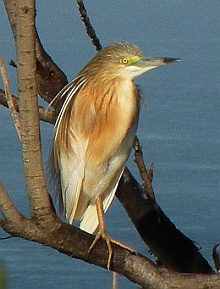 Squacco Heron Ardeola ralloides
© Teresa Farino
Unfortunately, however, although Bonelli's Eagles were the commonest large raptors of this region at the
end of the last century, they have declined dramatically, and take some tracking down today.
Squacco Heron Ardeola ralloides
© Teresa Farino
Unfortunately, however, although Bonelli's Eagles were the commonest large raptors of this region at the
end of the last century, they have declined dramatically, and take some tracking down today.
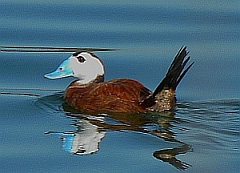
One of the ornithological highlights of the trip is a visit to a small coastal lagoon that attracts all manner of waterbirds on migration, with regular visitors including Squacco and Night Herons, White-headed Duck, Garganey, Marsh Harrier, Spotted Redshank, Collared Pratincole, Slender-billed, Audouin's and Mediterranean Gulls and Gull-billed Terns, among more commonplace species such as Little Egret, Black-winged Stilt, Kentish and Ringed Plovers, Sanderling, Curlew Sandpiper, Little Stint, Black-tailed and Bar-tailed Godwits, Sandwich and Whiskered Terns, Sand Martin and Yellow Wagtail. The Cabo de Gata salinas usually host small numbers of Greater Flamingo, as well as breeding Avocet, Kentish Plover, and Little and Common Terns, with the reedbeds here home to Cetti's, Reed and Great Reed Warblers.
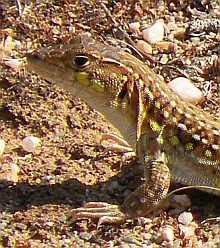 Spiny-footed Lizard
Acanthodactylus erythrurus
© Teresa Farino
Moorish Geckos, Spiny-footed Lizards and Large Psammodromuses are undoubtedly the most abundant reptiles, although we might also track down Turkish Gecko, Edward's Psammodromus, the quicksilver Bedriaga's Skink, Ladder and Western Montpellier Snakes and Lataste's Viper, as well as the distinctly grey-brown Sierra Nevada Ocellated Lizard that inhabits these semi-desert habitats. Where seasonal pools form in the ramblas, we could well encounter Spanish Terrapin, Viperine Snake, Iberian Water Frog and Natterjack Toad. Although this corner of Spain is home to Spanish Ibex, Algerian Hedgehog and Algerian Mouse, the most commonly seen mammals in the region are Rabbits and Iberian Hares.
Spring butterflies of the coastal regions include Mallow, Lulworth and Sage Skippers, Bath, Western Dappled and Green-striped Whites, Black-eyed and Lang's Short-tailed Blues, Southern Gatekeeper and Spanish Marbled White, as well as the tiny but very lovely Common Tiger Blue, which is often seen flying round the spiny, zigzagged stems of Ziziphus lotus, its larval host plant. The more vegetated habitats of the Sierras of Gádor and Los Filabres are home to a rather different butterfly community, the undoubted highlights of which are Sooty Orange Tip and False Baton Blue.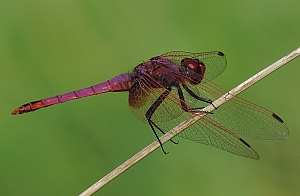 Male Violet Dropwing Trithemis annulata
© Teresa Farino We will also be keeping an eye out for the much rarer Desert Orange Tip, and Spanish Fritillary is also a possibility.
Male Violet Dropwing Trithemis annulata
© Teresa Farino We will also be keeping an eye out for the much rarer Desert Orange Tip, and Spanish Fritillary is also a possibility.
Among the most characteristic dragonflies and damselflies in this part of Almería are Iberian Bluetail, Black-tailed Skimmer, Southern Darter, Black Percher, Black Pennant and Violet Dropwing, the latter trio found only in southern Europe and North Africa. Other interesting invertebrates that we should encounter at this time of year are the scorpion Buthus occitanus, the fabulous Royal Oil-beetle (Berberomeloë insignis), which is endemic to the badlands of south-eastern Spain, nymphs of the handsome mantis Empusa pennata and several highly charismatic species of grasshoppers and crickets.
"Thank you very much for organising such an enjoyable and interesting trip to Almeria. I enjoyed it all very much - the wildlife, much of which was new to me, seeing so much of the area in the week, the early morning activities, the lovely lunches, the friendly good hotel, the very congenial company and the perfect weather. It all ran so smoothly - you had obviously put a lot of thought and time into the preparations. As my first experience of a wildlife holiday it was great." I Morgan April 2011
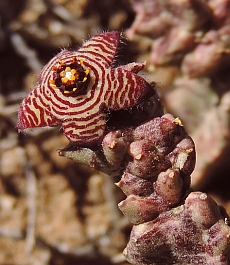 Caralluma europaea
© Teresa Farino
Caralluma europaea
© Teresa Farino
Wildlife of Almería
Leader: Teresa Farino
2018 Dates: Thurs 5 April – Thurs 12 April (8 days/7 nights)
Price: 1,450€ per person, including half-board, en suite accommodation at El Santuario, picnic lunches, minibus/4WD transport throughout, all entry fees and the services of the leader. A single-room supplement of 150€ is applicable.
Although the cost of this tour is given in euros, clients may pay in sterling, the exchange rate to be calculated at the time of payment using www.oanda.com
This is a land-based tour. Flights and travel insurance (obligatory) are the responsibility of the client.
Pick-up details: For this tour, participants will be booking their flights independently. Undoubtedly the most convenient airport for the tour is Almería itself, and as this is also something of a tourist 'sun & sea' hotspot, flights are available from several airlines operating out of a number of British airports, which should make your life as easy as possible.
 Royal Oil Beetle
Berberomeloë insignis
© Teresa Farino
Because AlmerÍa airport is only about 45 minutes drive from our hotel in San José, we can arrange the pick-up and drop off to suit you.
Alternatively, those travelling to Almería independently can arrange to meet the group at the hotel on the first evening.
Group size: maximum 8 clients.
Booking information: please contact Teresa Farino for further details and a booking form, or if you have any queries about this tour.
| E-mail: |
|
|
| Office phone: | (+34) 942 735154 |
| Mobile phone: | (+34) 656 337129 |
|
| Address: |
Apartado de Correos 59
39570 Potes
Cantabria
Spain
|
|