 |
Picos de Europa:
a naturalist's paradise
- part 2
by Teresa Farino
Alpine wildflowers and birds above Fuente Dé
Take a trip up in the Fuente Dé cable car and you'll find yourself in a maze of limestone rockgardens and springy turf at around 1,800m, on the edge of the central massif of the Picos de Europa. The first wildflowers to appear with the melting snows include drifts of 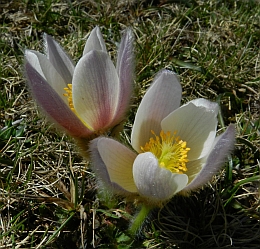 Spring Pasque Flower Pulsatilla vernalis © Teresa Farino spring and trumpet gentians, Narcissus asturiensis and spring squill. As spring arrives in earnest, these are joined by the delicate bluish-white blooms of Anemone pavoniana, unique to the Cordillera Cantábrica, and a wealth of saxifrages - purple, neglected, cone, livelong and Saxifraga felineri (confined to the Picos de Europa), to mention but a few - growing amid creeping carpets of the northern Iberian greenweed Genista legionensis. Look out too for pink sandwort, moss campion, Spring Pasque Flower Pulsatilla vernalis © Teresa Farino spring and trumpet gentians, Narcissus asturiensis and spring squill. As spring arrives in earnest, these are joined by the delicate bluish-white blooms of Anemone pavoniana, unique to the Cordillera Cantábrica, and a wealth of saxifrages - purple, neglected, cone, livelong and Saxifraga felineri (confined to the Picos de Europa), to mention but a few - growing amid creeping carpets of the northern Iberian greenweed Genista legionensis. Look out too for pink sandwort, moss campion, 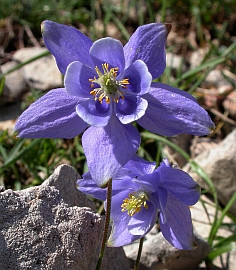 Aquilegia pyrenaica ssp. discolor © Teresa Farino the crucifers Draba dedeana and D. cantabriae, both of which are found only in northern Spain, Pyrenean vetch, Teesdale violet, the rock-jasmine Androsace villosa, hyssop-leaved sideritis, fairy foxglove, prostrate, alpine and Malling toadflaxes and fluffy mats of Globularia repens. More elusive, however, are parnassus-leaved buttercup, spring pasque flower, Potentilla nivalis ssp. asturica, the delicate, nodding alpine snowbell and dragonmouth. Aquilegia pyrenaica ssp. discolor © Teresa Farino the crucifers Draba dedeana and D. cantabriae, both of which are found only in northern Spain, Pyrenean vetch, Teesdale violet, the rock-jasmine Androsace villosa, hyssop-leaved sideritis, fairy foxglove, prostrate, alpine and Malling toadflaxes and fluffy mats of Globularia repens. More elusive, however, are parnassus-leaved buttercup, spring pasque flower, Potentilla nivalis ssp. asturica, the delicate, nodding alpine snowbell and dragonmouth.
In late June the characteristic high-altitude composites start to appear, notably pygmy hawk's-beard, alpine aster, Jurinea humilis, large-flowered leopard's-bane and the delightful woolly leaved hawkweed Hieracium mixtum, but you'll have to wait until July for some of the real specialities of the Picos de Europa: the diminutive columbine Aquilegia pyrenaica ssp. discolor, unique 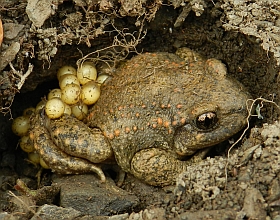 Midwife Toad Alytes obstetricans © Teresa Farino to these mountains, the houseleek Sempervivum vicentei ssp. cantabricum, confined to northern Spain, the rock storksbill Erodium glandulosum, alpine skullcap and the northern Spanish endemic bellflowers Campanula arvatica and C. cantabrica. Midwife Toad Alytes obstetricans © Teresa Farino to these mountains, the houseleek Sempervivum vicentei ssp. cantabricum, confined to northern Spain, the rock storksbill Erodium glandulosum, alpine skullcap and the northern Spanish endemic bellflowers Campanula arvatica and C. cantabrica.
Early in the year, isard (Pyrenean chamois) are relatively easy to see in the vicinity of the upper cable car station but take refuge in the higher mountains of the Picos de Europa with the onset of the summer tourist season. The same applies to wallcreepers, which can often be encountered on the main track up towards Cabaña Verónica in April and May, while hard winters find them in the depths of the gorges. The other alpine bird specialities of the Picos de Europa seem to be less wary of man, however, such within a few hundred metres of the top of the cable car you should come across snowfinch, alpine accentor, chough and alpine chough, 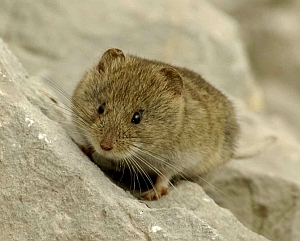 Snow Vole Chionomys nivalis © Matt Hobbs as well as good numbers of water pipit, wheatear and black redstart and the occasional rock thrush. The nearby pools of the Hoyos de Lloroza harbour an abundance of alpine newts and midwife toads, plus large red damsel and broad-bodied chaser in June, and if you sit quietly in the surrounding rockgardens you will almost certainly be inspected by a curious snow vole. Snow Vole Chionomys nivalis © Matt Hobbs as well as good numbers of water pipit, wheatear and black redstart and the occasional rock thrush. The nearby pools of the Hoyos de Lloroza harbour an abundance of alpine newts and midwife toads, plus large red damsel and broad-bodied chaser in June, and if you sit quietly in the surrounding rockgardens you will almost certainly be inspected by a curious snow vole.
Butterfly-wise, it is late June before the first Gavarnie blues appear (here the Picos de Europa endemic subspecies asturiensis), along with Lefèbvre's ringlet (again a race unique to the Picos de Europa: astur) around the screes. Look out too for large grizzled skipper, Queen of Spain fritillary, large wall brown and Piedmont and common brassy ringlets, all of which are abundant here at this time of year, with mountain clouded yellow, Shepherd's fritillary and silky ringlet appearing from July onwards.
|





