 |
Fauna of the Serra da Arrábida
The Arrábida's essentially natural vegetation supports a wide variety of animal life; 213
vertebrates have been recorded in this Portuguese natural park, as well as 300 species of
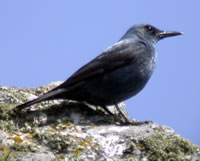 Blue Rock Thrush
Monticola solitarius
© John Muddeman
Lepidoptera, including swallowtail, Spanish Swallowtail, Spanish festoon, marsh fritillary
and Lorquin's blue. The thick Mediterranean scrub finds favour with Sardinian and Dartford
warblers, as well as harbouring numerous reptiles, notably spiny-footed lizard, large psammodromus
and the Iberian endemic Bedriaga's skink, plus ladder, Montpellier and horseshoe whip snakes.
Rather more surprising is the presence of amphibians such as west Iberian painted frog and western
spadefoot in this habitat.
The forest formations - both the Lusitanian oak groves and the montados (wood-pastures) of cork
and western holm oaks in the peripheral areas of the park - support breeding sparrowhawk, cuckoo,
tawny and little owls, bee-eater, hoopoe, wryneck, short-toed treecreeper, woodchat shrike and
hawfinch, the latter especially associated with stands of Montpellier maple. Rabbits are joined
by Iberian hares here, while mammalian predators include western polecat, weasel, beech marten,
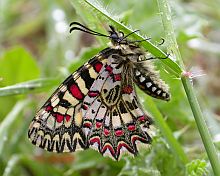 Spanish Festoon Zerynthia rumina
© Teresa Farino
Eurasian badger, common genet and Egyptian mongoose. More open areas among the montados provide
suitable habitat for Iberian wall and ocellated lizards, Spanish psammodromus and three-toed
skink.
Spanish Festoon Zerynthia rumina
© Teresa Farino
Eurasian badger, common genet and Egyptian mongoose. More open areas among the montados provide
suitable habitat for Iberian wall and ocellated lizards, Spanish psammodromus and three-toed
skink.
Perhaps the most noteworthy birds of the Arrábida are those which nest on the sheer limestone
cliffs, including a lone pair of Bonelli's eagles, as well as peregrine, rock dove, alpine and
pallid swifts (the latter in large colonies), black redstart and blue rock thrush. The honeycomb
nature of the limestone here has given rise to a number of natural caves, utilised by large
breeding colonies of Schreiber's bats (up to 10,000 individuals) and by smaller numbers of
hibernating Mehely's horseshoe bats. Greater mouse-eared, greater and Mediterranean horseshoe
and European free-tailed bats have also been recorded in the park.
|





